Medicare Therapy Threshold Mistakes US PT Practices Make
Aug 24, 2026
For months, everything runs smoothly. Claims go out, claims get paid, and cash flow looks healthy. Then, seemingly out o...
Read More →
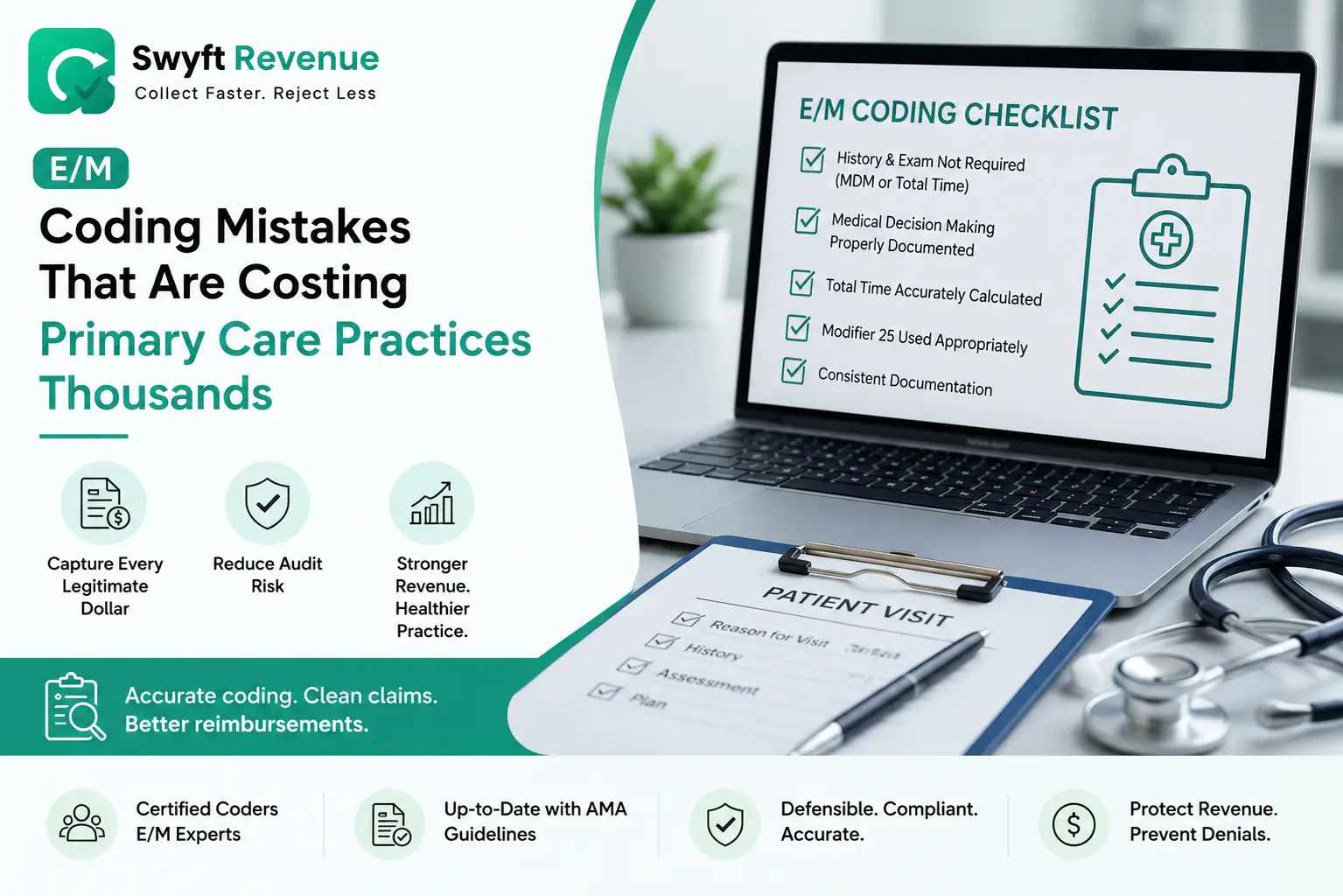
Evaluation & Management (E/M) coding is the backbone of primary care billing nearly every patient visit runs through it. Yet it's also one of the most error-prone areas in medical coding, especially since the AMA's 2021 and 2023 guideline updates changed how visit levels are determined.
The result? Many primary care practices are either under coding, quietly losing revenue on every visit, or over coding, quietly increasing their audit risk. Neither is where you want to be.
Here are the most common E/M coding mistakes we see, and how to fix each one.
1. Still Coding Based on the Old 1995/1997 Guidelines
Some practices are still applying the older history and exam based documentation rules, even though visit levels for office and outpatient E/M codes are now determined by medical decision making (MDM) or total time.
2. Confusing Time Based and MDM Based Coding
Providers can code a visit based on either total time spent or the complexity of medical decision making, whichever is higher, but many practices default to only one method without checking which actually supports a higher, more accurate level.
3. Under Documenting Medical Decision Making Complexity
MDM level depends on three factors: the number and complexity of problems addressed, the amount of data reviewed, and the risk of complications. If documentation doesn't clearly reflect all three, the visit often gets coded lower than it should be.
4. Incorrect Use of Modifier 25
Modifier 25 is used when a significant, separately identifiable E/M service is provided on the same day as a procedure. It's frequently overused, underused, or attached without documentation that clearly supports it, both of which raise red flags with payers.
5. Miscounting Total Time for Time Based Coding
When coding by time, practices sometimes forget to include all qualifying activities, like chart review before the visit or counseling and care coordination, which can result in a lower level than the visit actually earned.
6. Inconsistent Documentation Across Providers
In multi provider practices, it's common for each physician to document differently, leading to inconsistent coding accuracy across the same practice.
7. Not Auditing Coding Patterns Regularly
Many practices code the same way month after month without ever checking whether their coding distribution (how often each level is billed) is realistic or a red flag for payers.
The Real Cost of E/M Coding Errors
Under coding means leaving legitimate revenue on the table, visit after visit, patient after patient. Over coding, on the other hand, increases audit risk and potential claw backs. Either way, inconsistent E/M coding quietly erodes both your revenue and your compliance standing over time.
How Swyft Revenue Helps Primary Care Practices Code Accurately
At Swyft Revenue, our certified coders stay current on E/M guideline changes and review every visit for accurate, defensible coding, so you're neither leaving money on the table nor carrying unnecessary audit risk.
Ready to find out if your E/M coding is costing you revenue? Get a Free Billing Analysis →
Want to talk through your practice's coding patterns? Contact our team at support@swyftrevenue.com — we're happy to help.