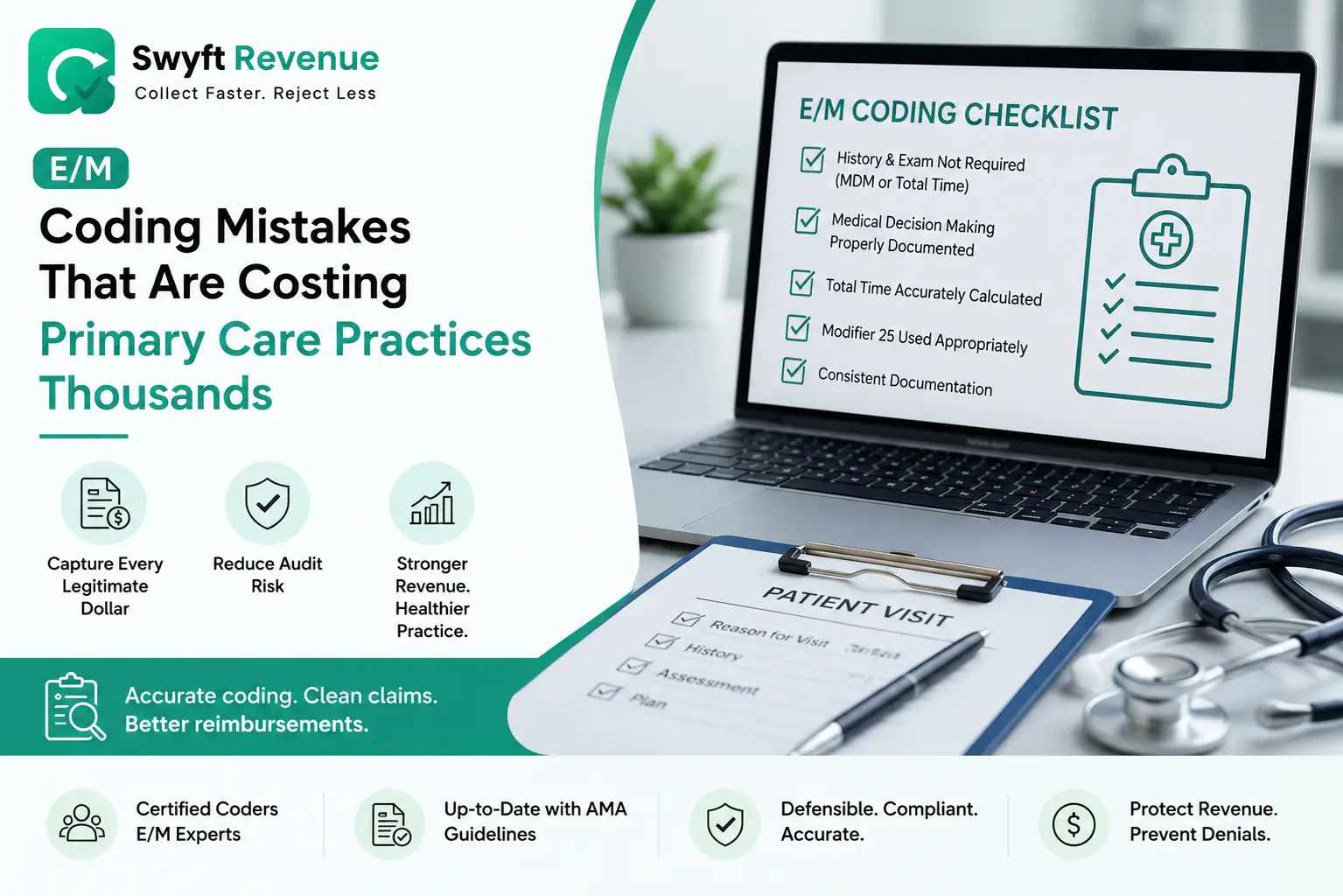
E/M Coding Mistakes That Are Costing Primary Care Practices Thousands
Aug 21, 2026
Evaluation & Management (E/M) coding is the backbone of primary care billing nearly every patient visit runs through it....
Read More →
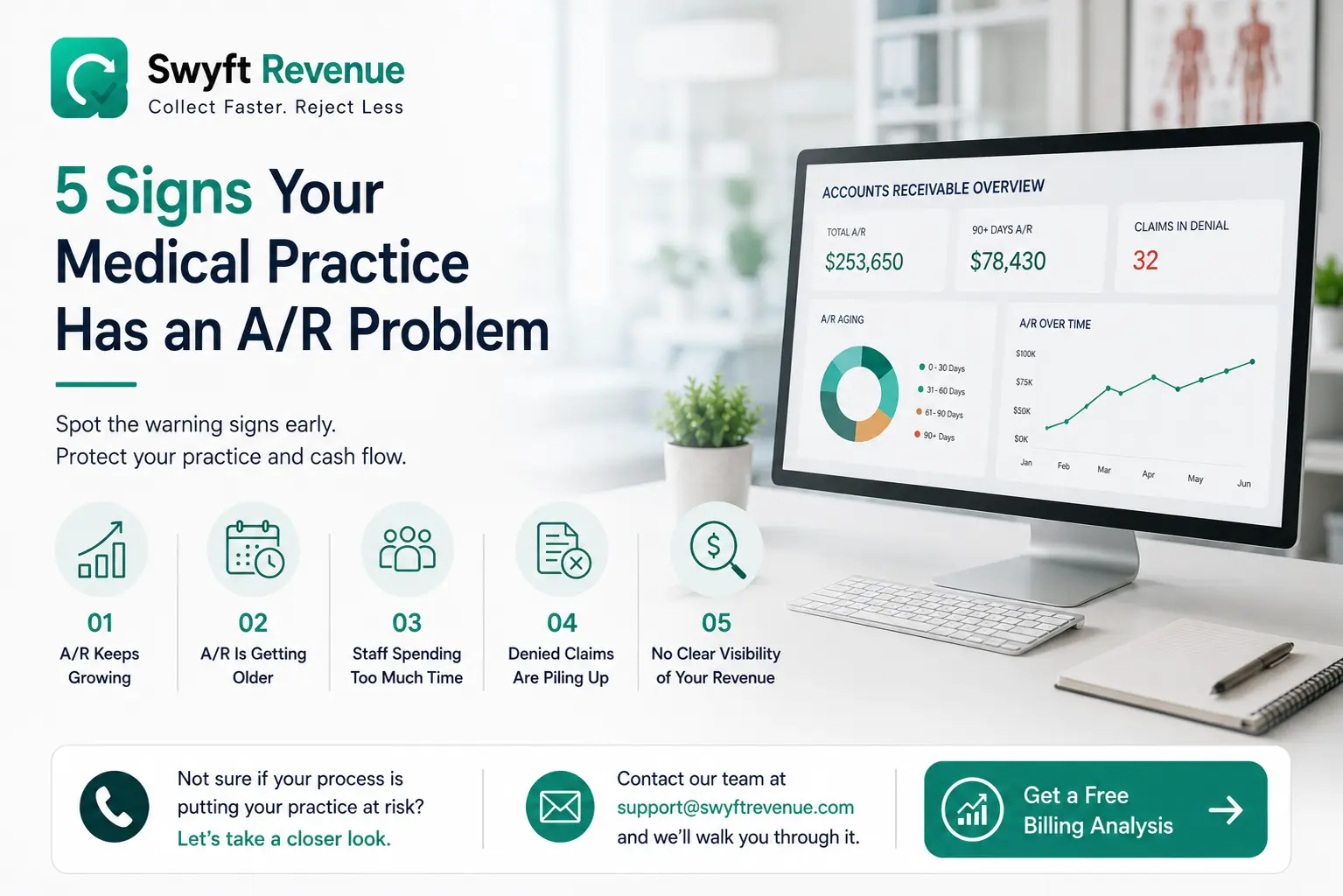
Your medical practice may be busy seeing patients, submitting claims, and providing excellent care but that does not necessarily mean your revenue cycle is healthy.
If insurance payments are delayed, unpaid claims continue to accumulate, or your accounts receivable keeps growing, your practice may have an A/R problem.
For independent medical practices and small physician practices, this can quickly become a cash flow problem. Revenue you have already earned can remain tied up in unpaid claims while your staff spends valuable time tracking payments, contacting payers, correcting billing issues, and trying to determine why money has not reached your practice.
And the longer these issues remain unresolved, the more difficult they can become to manage.
Here are five signs that your practice's A/R may deserve professional attention.
1. Your Accounts Receivable Keeps Growing
A certain amount of A/R is normal for any medical practice.
The concern begins when your outstanding balance continues increasing while your collections fail to keep pace.
A growing A/R balance can point to problems throughout the medical billing and revenue cycle management process, including:
The problem is that an A/R report can show how much money is outstanding without telling you how much revenue is actually at risk.
For a practice owner, that uncertainty can make it difficult to know whether your billing operation is performing as it should.
2. Your A/R Is Getting Older
A growing A/R balance is concerning.
An aging A/R balance can be even more concerning.
When claims move from 30 to 60, 90, or 120+ days without payment, they require increasing attention. At that point, your practice isn't simply waiting for a payment it is carrying revenue that has remained unresolved for an extended period.
Older A/R may involve:
For an independent physician practice, hundreds or thousands of dollars sitting in aging A/R can represent revenue that could otherwise support payroll, operations, equipment, staffing, or growth.
If your team is routinely carrying old A/R from one month to the next, the issue may be deeper than a few unpaid claims.
3. Your Staff Is Spending Too Much Time Chasing Payments
How much time does your staff spend calling insurance companies, checking claim statuses, investigating unpaid balances, correcting billing issues, and following up on outstanding claims?
If your answer is "too much," your practice may be carrying a revenue cycle workload that your internal team was never designed to manage.
Medical billing is not simply about submitting a claim.
It involves continuous attention to payer responses, claim status, denials, documentation, coding, eligibility, A/R, patient balances, and changing payer requirements.
For a small practice, expecting front-office or administrative employees to manage all of this while handling their normal responsibilities can create an impossible workload.
And when billing follow up gets pushed aside because the practice is busy, unpaid claims don't stop accumulating.
This is one of the reasons practices turn to outsourced medical billing and revenue cycle management.
4. Denied Claims Are Becoming Part of Your A/R
A denied claim is more than a temporary payment delay.
It creates another task for someone on your team.
The claim needs to be investigated. The reason for the denial needs to be understood. The appropriate action needs to be determined. Documentation or claim information may need to be reviewed. And then the claim needs continued attention until the issue is resolved.
Now multiply that process across dozens or potentially hundreds of claims.
Suddenly, your practice isn't dealing with one denial.
It has a revenue cycle workload.
When denials continue appearing in your A/R, it can indicate that underlying billing, coding, eligibility, authorization, or payer related issues are not being addressed consistently.
And while your staff is working through those problems, your practice is still waiting to be paid.
5. You Don't Know Where Your Revenue Is Getting Stuck
This may be the biggest warning sign of all.
If someone asked you today:
"How much money is currently sitting in A/R?"
Could you answer?
What about:
"How much of that A/R is more than 90 days old?"
"Which payers owe us the most?"
"How much are we losing or delaying because of denials?"
"Which claims require immediate attention?"
"Are our collections improving or declining?"
If those answers aren't readily available, your practice may not have the revenue visibility it needs.
Without clear revenue reporting, it becomes difficult to understand where money is being delayed, where problems are recurring, and whether your current billing process is actually performing efficiently.
You shouldn't have to discover a revenue problem after the money is already missing from your expected cash flow.
The Bigger Problem Behind A/R
An A/R problem rarely exists by itself.
Growing A/R can be connected to claim denials.
Denials can be connected to billing and coding issues.
Billing issues can be connected to eligibility, documentation, authorization, or payer requirements.
And all of these issues require time, knowledge, follow up, and consistent oversight.
That is why A/R should not be viewed as simply an accounting number.
It is a reflection of what is happening throughout your healthcare revenue cycle.
If one part of the process is consistently underperforming, the financial impact can eventually show up in your A/R.
Why A/R Problems Keep Getting Worse
The difficult part about A/R is that the problem can continue growing while the practice is busy doing everything else.
Your providers are seeing patients.
Your staff is managing appointments.
Your office is handling phone calls.
New claims are being submitted.
New patients are coming in.
Meanwhile, older claims are waiting for attention.
Without dedicated revenue cycle oversight, it becomes easy for outstanding claims to move further into the aging cycle while newer work continues to pile up.
Eventually, your practice may find itself spending more time trying to recover old revenue than preventing the next A/R problem.
That is not a situation most physicians or practice managers want their staff dealing with.
Your Billing Shouldn't Depend on Someone "Finding Time"
Effective accounts receivable management requires consistent attention.
Claims cannot simply be submitted and forgotten.
Outstanding balances cannot be allowed to sit indefinitely.
Denials cannot be treated as occasional administrative inconveniences.
And practice owners should not have to personally monitor every unpaid claim to know whether their revenue cycle is working.
This is where professional medical billing and RCM support becomes valuable.
Instead of expecting your clinical or administrative staff to become experts in the entire revenue cycle, your practice can have specialists focused specifically on the financial side of healthcare.
Where Swyft Revenue Fits In
Swyft Revenue provides medical billing and revenue cycle management services for independent and small healthcare practices.
Our team handles the revenue cycle activities that can otherwise consume your staff's time from billing and coding to claims submission, denial management, A/R follow-up, insurance eligibility verification, patient collections, and revenue reporting.
The objective isn't simply to produce another A/R report.
It is to help ensure that the revenue your practice earns does not remain unnecessarily stuck somewhere in the billing cycle.
Your staff should be focused on your patients.
Your revenue cycle should have specialists focused on your revenue.
Is Your Practice's A/R Under Control?
If your practice is experiencing:
then your A/R deserves more than a quick monthly review.
It deserves a professional assessment.
Find Out What Your A/R Is Really Telling You
You may know how much your practice has outstanding.
The more important question is:
How much of that revenue should already be in your bank account?
Swyft Revenue can review your current billing and A/R performance and identify where your revenue cycle may be falling short.
Get Your Free Revenue Audit
Email: support@swyftrevenue.com
Ready to find out where your practice may be losing revenue?
Get Your Free Revenue Audit → https://swyftrevenue.com/contact
Swyft Revenue — Your Revenue. Our Responsibility.